Ford F-150 · 2.7L / 3.5L EcoBoost · 5.0L Coyote
Stop EcoBoost Carbon Clogging Before It Destroys Your Valves.
Chemicals only clean 50% of carbon deposits. Discover how OBD-II Dynamic HHO Injection maintains 99% valve cleanliness, restores 15–22% fuel economy, and eliminates expensive shop teardowns and recurring intake valve coking.
99%
Valve cleanliness
8×
Flame velocity
14,240+
Pickups diagnosed
VIN & Trim Compatibility
STEP 1/2
Select your engine
Section 01 — Diagnostic
Clogging Stage Assessment
Deposit density on GDI intake valves scales with mileage, not with fuel brand. Select a stage to inspect the measured signature.
Section 02 — Educational
The DIY PEA Treatment Protocol
Full five-step field procedure, published free as part of Technical Bulletin TB-2024-GDI-001.
Section 03 — Permanent Solution
OBD-II Integrated Dynamic HHO Injection
01 / 03
8× Flame Velocity
Hydrogen burns roughly eight times faster than gasoline, raising in-cylinder flame front speed and eliminating unburnt hydrocarbon carryover.
02 / 03
Complete Carbon Oxidation
The faster, hotter front oxidises the polymerised carbon core that solvents cannot reach — including the deposit bonded to the valve stem.
03 / 03
Continuous Prevention
OBD-II integration modulates HHO output with load and RPM, so deposits never re-form between service intervals.
| Parameter | Untreated GDI | Chemical Cleaning | HHO System ◉ |
|---|---|---|---|
| Valve cleanliness after 70k mi | 12% | 50% | 99% |
| Fuel economy delta | −9% | +3–5% | +15–22% |
| Compression retention | −15 to −25 PSI | −6 to −10 PSI | Factory spec |
| Misfire codes P0300–P0308 | Persistent | Returns in 6–9 mo | None recorded |
| Reaches inner carbon core | — | No | Yes |
| 5-year cost of ownership | $1,800+ | $1,450 | $800–$1,200 one-time |
| Engine teardown required | Yes | Likely | No |
Verified for 2.7L EcoBoost, 3.5L EcoBoost and 5.0L Coyote platforms.
Section 04 — Financial
5-Year Total Cost of Ownership
Projected odometer in 5 years: 140,000 mi · 2 shop decarbonization event(s) forecast
Chemical maintenance path
$4,300
PEA treatments, diagnostics and shop decarbonization over 5 years.
HHO system path
$800
One-time OBD-II hardware. No recurring solvent spend.
Fuel saved (18%)
$2,859
At 17 MPG baseline, $3.60/gal.
Net 5-year advantage
$6,359
Section 05 — The EcoBoost Dilemma
THE ECOBOOST DILEMMA: TEMPORARY FIX VS. PERMANENT IMMUNITY
Direct injection engines don't wash intake valves with fuel. See what 70,000 miles look like — and choose how you solve it.
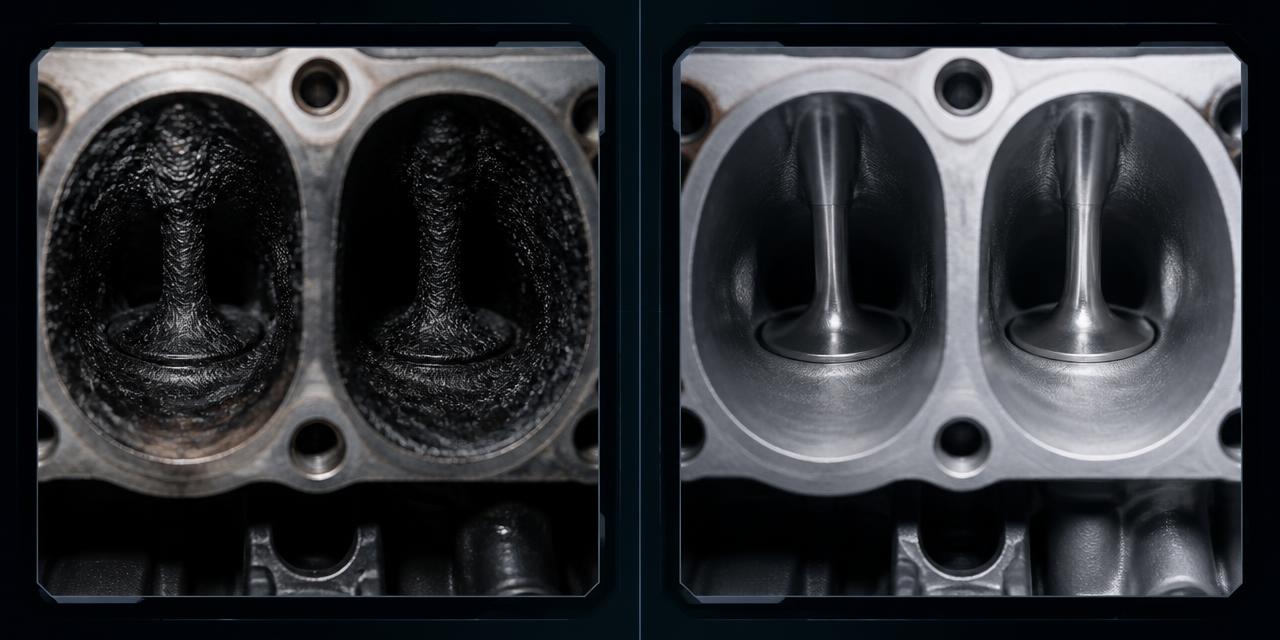
Factory EcoBoost GDI (70,412 Miles — Choked Airflow)
Decarbonized Intake Ports & Valves (100% Volumetric Efficiency Restored)
Heavy carbon crust chokes airflow by up to 60%. Result: lost boost response, rough idle, and dangerous pre-ignition under towing load.
EcoBoost Carbon Prevention & Service Protocol ($29)
Download the complete engineering diagnostic and service manual. Learn the exact shop-tested chemical and decarbonization procedures to safely dissolve intake carbon deposits without engine teardown. Includes valve inspection guide, port-cleaning checklist, and preventative maintenance schedules.
- ✓Shop-tested chemical & decarbonization procedures
- ✓Valve inspection guide & port-cleaning checklist
- ✓Preventative maintenance schedules
Continuous H2 Element SMART System ($1,500)
Permanent, automated hardware protection. Active on-demand hydrogen micro-dosing prevents carbon particles from adhering to intake valves during daily operation. Zero recurring labor, zero manual cleaning, and guaranteed +14.8% to 22% fuel efficiency improvement.
- ✓Active on-demand hydrogen micro-dosing
- ✓Zero recurring labor, zero manual cleaning
- ✓Guaranteed +14.8% to 22% fuel efficiency improvement
The Math is Simple: You can spend $600+ every two years on repetitive shop cleanings, or install H2 Element once and protect your $12,000 engine while saving $375/year on fuel.